"The best weapon is to sit down and talk."
These are the words of Nelson Mandela, the former president of South Africa.
Mandela, who fought against apartheid, was imprisoned on Robben Island for 27 years on charges of state treason. After his release, he returned to the work of dismantling apartheid. The path he chose was not confrontation with his enemies, but the dialogue his words point toward.
I recently learned that a chair named after this line, The Best Weapon, sits in front of the Nobel Peace Center in Oslo.
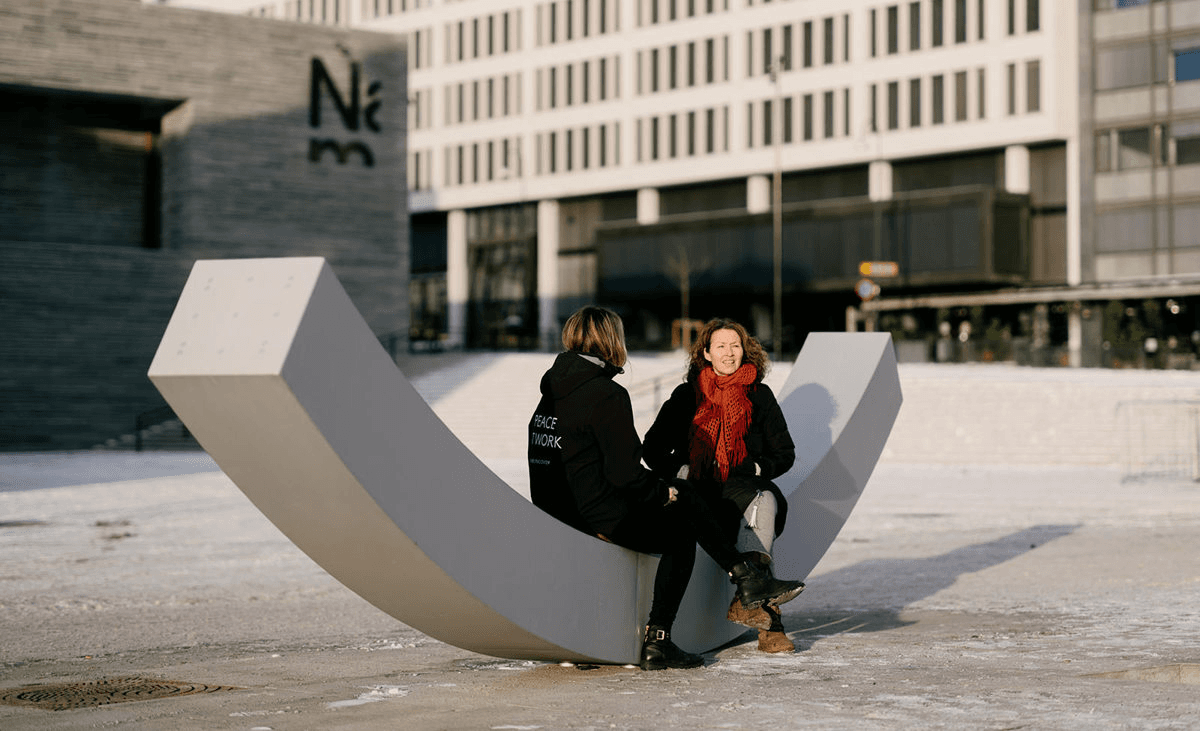
The chair traces a gentle arc.
It's designed so that the people who sit on it are naturally drawn slightly closer to each other.
By sitting down, the distance to another person shrinks just a little. And then, almost without noticing, words begin to be exchanged. The piece sits there as something that gently invites peaceful dialogue.
When I learned about it, I was moved more than I can put into words. A single, simple arc that quietly embeds an act toward peace. There's something irresistibly lovely, too, about the way it makes you "lean a little closer without quite meaning to."
What happens before "we talk"
These days, "dialogue is important" is something I hear in a lot of places.
People face one another, exchange words, come to understand each other.
It's a beautiful scene, no doubt about it.
But isn't dialogue with someone you've just met, fundamentally, a very high psychological bar to clear?
When you say, "We're hosting a space for dialogue," how many people actually feel able to show up? And if only the people who can show up end up talking with each other, can we really call that "having a dialogue"?
There's a passage in Oriza Hirata's Wakariaenai Koto Kara ("Starting from Not Being Able to Understand Each Other"):
Japanese expression education up to now has only ever looked to me like teachers gripping children by the throat and shouting, "Express yourself! Express yourself!" Those teachers are usually the passionate ones, and the people around them feel something is off but can't speak up. Whenever I see a passionate teacher like that, I always want to walk up quietly from behind, tap them on the shoulder, and say, "No, that child isn't trying to express themselves yet."
― Wakariaenai Koto Kara | Oriza Hirata
This is about expression education, but I think the same goes for dialogue.
"No, that person isn't trying to have a dialogue yet."
What invites communication
For a dialogue to begin, there must be something before it. Some kind of small trigger.
And this piece designs that trigger in a really lovely form. It doesn't force you to engage, and it doesn't leave it entirely up to you either; with just a gentle curve, in exactly the right balance, it draws people a little closer to each other.
The small step that comes before dialogue. This chair feels like it's teaching me what design can do for that step.